decrypting…# MITRE ATT&CK Framework 🎯 #KA #CTI Welcome to the **MITRE ATT&CK Framework** documentation! This page provides a comprehensive breakdown of the framework, its features, and a deep dive into every component. --- 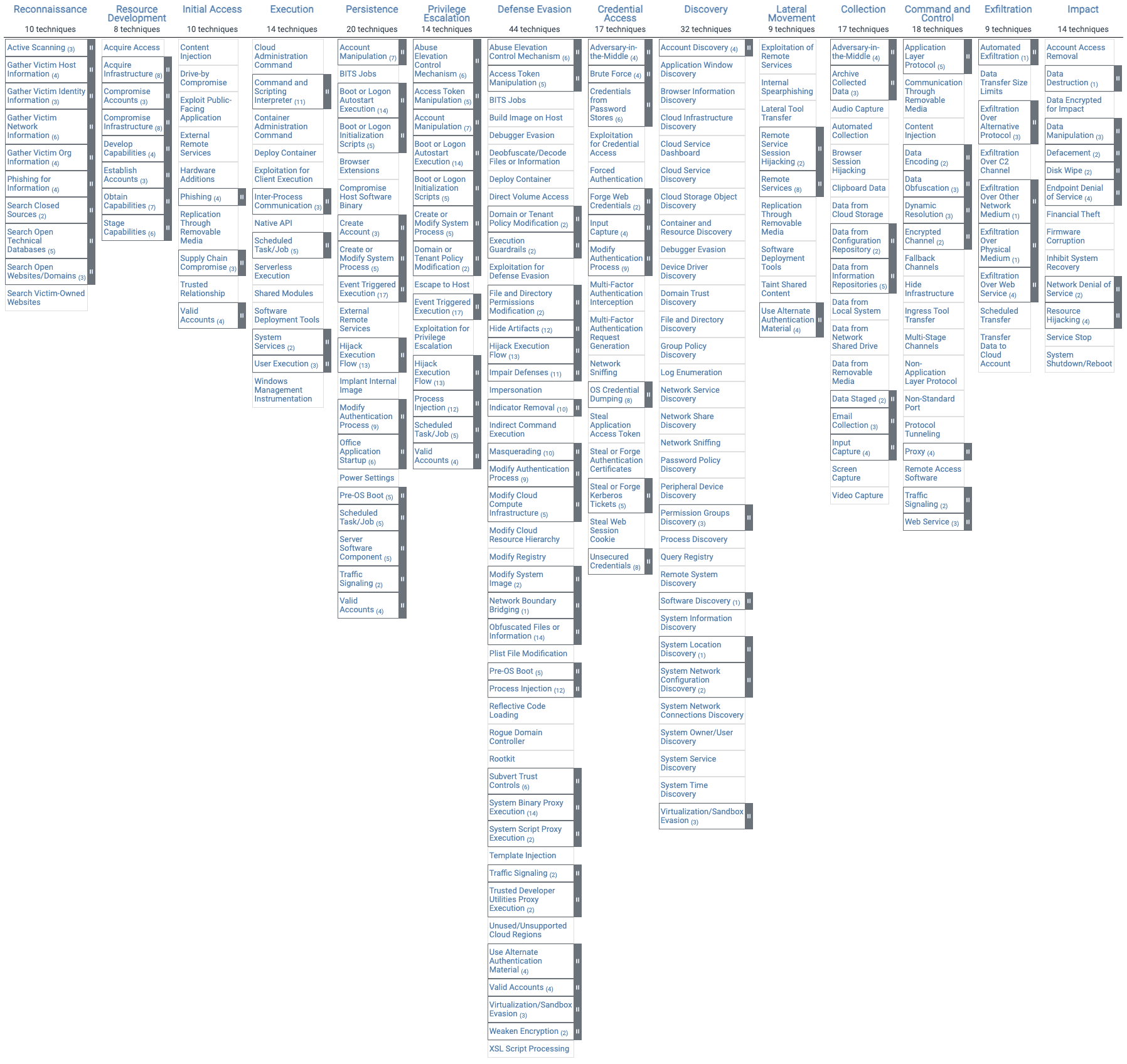 --- ## What is the MITRE ATT&CK Framework? 🌐 The **MITRE ATT&CK Framework** is a globally-accessible knowledge base of adversary tactics and techniques based on real-world observations. It provides a structured approach to understanding, defending against, and mitigating cyber threats. --- ## Features 🚀 - **Comprehensive Knowledge Base:** Documented techniques and tactics based on real-world cyber threats. - **Defensive Strategy Insights:** Guides security teams on identifying and mitigating threats effectively. - **Customization:** Tailored to fit different industries and organizations. - **Community Support:** Widely used and constantly updated by cybersecurity experts. --- ## Diagram Overview 📊 ```mermaid flowchart TD A["Reconnaissance"] --> A1["Active Scanning"] A1 --> A2["Gather Victim Host Information"] A2 --> A3["Gather Victim Identity Information"] A3 --> A4["Gather Victim Network Information"] A4 --> A5["Gather Victim Org Information"] A5 --> A6["Phishing For Information"] A6 --> A7["Search Closed Sources"] A7 --> A8["Search Open Technical Databases"] A8 --> A9["Search Open Websites/Domains"] A9 --> A10["Search Victim-Owned Websites"] B["Resource Devopment"] --> B1["Acquire Access"] B1 --> B2["Aquire Infrastructure"] B2 --> B3["Compromise Accounts"] B3 --> B4["Compromise Infrastructure"] B4 --> B5["Develop Capabilities"] B5 --> B6["Establish Accounts"] B6 --> B7["Obtain Capabilities"] B7 --> B8["Stage Capabilities"] C["Initial Access"] --> C1["eContent Injection"] C1 --> C2["Drive By Compromise"] C2 --> C3["Exploit Public Facing Application"] C3 --> C4["External Remote Services"] C4 --> C5["Hardware Additions"] C5 --> C6["Phishing"] C6 --> C7["Replication Through Removable Media"] C7 --> C8["Supply Chain Compramise"] C8 --> C9["Trusted Relationship"] C9 --> C10["Valid Accounts"] D["Execution"] --> D1["Cloud Administration Command"] D1 --> D2["Command and Scripting Interpreter"] D2 --> D3["Container Administration Command"] D3 --> D4["Deploy Container"] D4 --> D5["Exploitation for Client Execution"] D5 --> D6["Inter-Process Communication"] D6 --> D7["Native API"] D7 --> D8["Scheduled Task/Job"] D8 --> D9["Serverless Execution"] D9 --> D10["Shared Modules"] D10 --> D11["Software Deployment Tools"] D11 --> D12["System Services"] D12 --> D13["User Execution"] D13 --> D14["Windows Management Instrumentation"] E["Persistance"] --> E1["Account Manipulation"] E1 --> E2["BITS Jobs"] E2 --> E3["Boot or Logon Autostart Execution"] E3 --> E4["Boot or Logon Initialization Scripts"] E4 --> E5["Browser Extentions"] E5 --> E6["Compramise Host Software Binary"] E6 --> E7["Create Account"] E7 --> E8["Create or Modify System Process"] E8 --> E9["Event Triggered Execution"] E9 --> E10["External Remote Services"] E10 --> E11["Hijack Execution Flow"] E11 --> E12["Implant Internal Image"] E12 --> E13["Modify Authentication Process"] E13 --> E14["Office Application Startup"] E14 --> E15["Power Settings"] E15 --> E16["Pre-OS Boot"] E16 --> E17["Scheduled Task/Job"] E17 --> E18["Server Software Component"] E18 --> E19["Traffic Signaling"] E19 --> E20["Valid Accounts"] F["Privilege Escallation"] --> F1["Abuse Elevation Control Mechanism"] F1 --> F2["Access Token Manipulation"] F2 --> F3["Account Manipulation"] F3 --> F4["Boot or Logon Autostart Execution"] F4 --> F5["Boot or Logon Initialization Scripts"] F5 --> F6["Create or Modify System Process"] F6 --> F7["Domain or Tenant Policy Modification"] F7 --> F8["Escape to Host"] F8 --> F9["Event Triggered Execution"] F9 --> F10["Exploitation for Privilege Escalation"] F10 --> F11["Hijack Execution Flow"] F11 --> F12["Process Injection"] F12 --> F13["Schedule Task/Job"] F13 --> F14["Valid Accounts"] G["Defense Evasion"] --> G1["Abuse Elevation Control Mechanism"] G1 --> G2["Access Token Manipulation"] G2 --> G3["BITS Job"] G3 --> G4["Build Image on Host"] G4 --> G5["Debugger Evasion"] G5 --> G6["Deobfuscate/Decode Files or Information"] G6 --> G7["Deploy Container"] G7 --> G8["Direct Volume Access"] G8 --> G9["Domain or Tenant Policy Modification"] G9 --> G10["Execution Guardrails"] G10 --> G11["Exploitation for Defense Evasion"] G11 --> G12["Files and Directory Permissions Modification"] G12 --> G13["Hide Artifacts"] G13 --> G14["Hijack Execution Flow"] G14 --> G15["Impair Defenses"] G15 --> G16["Impersonation"] G16 --> G17["Indicatior Removal"] G17 --> G18["Indirect Command Exection"] G18 --> G19["Masquerading"] G19 --> G20["Modify Authentication Process"] G20 --> G21["Modify Cloud Compute Infrastructure"] G21 --> G22["Modify Cloud Resource Hierarchy"] G22 --> G23["Modify Registry"] G23 --> G24["Modify System Image"] G24 --> G25["Network Boundry Bridging"] G25 --> G26["Obfuscated Files or Information"] G26 --> G27["Plist Files Modification"] G27 --> G28["Pre-OS Boot"] G28 --> G29["Process Injection"] G29 --> G30["Reflective Code Loading"] G30 --> G31["Rogue Domain Controller"] G31 --> G32["Rootkit"] G32 --> G33["Subvert Trust Controls"] G33 --> G34["System Binary Proxy Execution"] G34 --> G35["System Script Proxy Execution"] G35 --> G36["Template Injection"] G36 --> G37["Traffic Signaling"] G37 --> G38["Trusted Developer Utilises Proxy Execution"] G38 --> G39["Unused/Unsuported Cloud Regions"] G39 --> G40["Use Alternate Authentication Material"] G40 --> G41["Valid Accounts"] G41 --> G42["Virtualization/Sandbox Evasion"] G42 --> G43["Weaken Encryption"] G43 --> G44["XSL Script Processing"] H["Credential Access"] --> H1["Adversary-In-The-Middle"] H1 --> H2["Brute Force"] H2 --> H3["Credentials from Password Strores"] H3 --> H4["Exploitation for Credential Access"] H4 --> H5["Forced Authentication"] H5 --> H6["Forge Web Credentials"] H6 --> H7["Input Capture"] H7 --> H8["Modify Authentication Process"] H8 --> H9["Multi-Factor Authentication Interception"] H9 --> H10["Multi-Factor Authentication Request Generation"] H10 --> H11["Network Sniffing"] H11 --> H12["OS Credential Dumping"] H12 --> H13["Steal Application Access Token"] H13 --> H14["Steal or Forge Authentication Certificates"] H14 --> H15["Steal or Forge Kerberos Tickets"] H15 --> H16["Steal Web Session Cookie"] H16 --> H17["Unsecured Credentials"] I["Discovery"] --> I1["Account Discovery"] I1 --> I2["Application Window Discovery"] I2 --> I3["Browser Information Discovery"] I3 --> I4["Cloud Infrastucture Discovery"] I4 --> I5["Cloud Service Dashboard"] I5 --> I6["Cloud Service Discovery"] I6 --> I7["Cloud Storage Object Discovery"] I7 --> I8["Container and Resource Discovery"] I8 --> I9["Debugger Evasion"] I9 --> I10["Device Driver Discovery"] I10 --> I11["Domain Trust Discovery"] I11 --> I12["Files and Directory Discovery"] I12 --> I13["Group Policy Discovery"] I13 --> I14["Log Enumeration"] I14 --> I15["Network Service Discovery"] I15 --> I16["Network Share Discovery"] I16 --> I17["Network Sniffing"] I17 --> I18["Password Policy Discovery"] I18 --> I19["Peripheral Device Discovery"] I19 --> I20["Permission Groups Discovery"] I20 --> I21["Process Discovery"] I21 --> I22["Query Registry"] I22 --> I23["Remote System Discovery"] I23 --> I24["Software Discovery"] I24 --> I25["System Information Discovery"] I25 --> I26["System Location Discovery"] I26 --> I27["System Network Configuration Discovery"] I27 --> I28["System Network Connection Discovery"] I28 --> I29["System Owner/User Discovery"] I29 --> I30["System Service Discovery"] I30 --> I31["System Time Discovery"] I31 --> I32["Virtualization/Sandbox Evasion"] J["Lateral Movement"] --> J1["Exploitation of Remote Services"] J1 --> J2["Internal Spearphishing"] J2 --> J3["Leteral Tool Transfer"] J3 --> J4["Remote Service Session Hijacking"] J4 --> J5["Remote Services"] J5 --> J6["Replication Through Removable Media"] J6 --> J7["Software Deployment Tools"] J7 --> J8["Taint Shared Content"] J8 --> J9["Use Alternative Authentication Material"] K["Collection"] --> K1["Adversary-In-The-Middle"] K1 --> K2["Archive Collected Data"] K2 --> K3["Audio Capture"] K3 --> K4["Automated Collection"] K4 --> K5["Browser Session Hijacking"] K5 --> K6["Clipboard Data"] K6 --> K7["Data from Cloud Storage"] K7 --> K8["Data from Configuration Repositories"] K8 --> K9["Data from Information Repositories"] K9 --> K10["Data from Local System"] K10 --> K11["Data from Network Shared Drive"] K11 --> K12["Data from Removable Media"] K12 --> K13["Data Staged"] K13 --> K14["Email Collection"] K14 --> K15["Input Capture"] K15 --> K16["Screen Capture"] K16 --> K17["Video Capture"] L["Command and Control"] --> L1["Application Layer Protocol"] L1 --> L2["Communication Through Removable Media"] L2 --> L3["Content Injection"] L3 --> L4["Data Encoding"] L4 --> L5["Data Obfuscation"] L5 --> L6["Dynamic Resolution"] L6 --> L7["Encrypted Channel"] L7 --> L8["Fallback Channels"] L8 --> L9["Hide Infrastructure"] L9 --> L10["Ingress Tool Transfer"] L10 --> L11["Multi-Stage Channels"] L11 --> L12["Non-Application Layer Protocol"] L12 --> L13["Non-Standard Port"] L13 --> L14["Protocol Tunneling"] L14 --> L15["Proxy"] L15 --> L16["Remote Access Software"] L16 --> L17["Traffic Signaling"] L17 --> L18["Web Service"] M["Exfiltration"] --> M1["Automated Exfiltration"] M1 --> M2["Data Transfer Size Limits"] M2 --> M3["Exfiltration Over Alterative Protocol"] M3 --> M4["Exfiltration Over C2 Channel"] M4 --> M5["Exfiltration Over Other Network Medium"] M5 --> M6["Exfiltration Over Phisical Medium"] M6 --> M7["Exfiltration over Web Service"] M7 --> M8["Schedule Transfer"] M8 --> M9["Transfer Data To Cloud Account"] N["Impact"] --> N1["Account Acccess Removal"] N1 --> N2["Data Destruction"] N2 --> N3["Data Encrypted for Impact"] N3 --> N4["Data Manipulation"] N4 --> N5["Defacement"] N5 --> N6["Disk Wipe"] N6 --> N7["Endpoint Denial of Service"] N7 --> N8["Financial Theft"] N8 --> N9["Firmware Corruption"] N9 --> N10["Inhibit System Recovery"] N10 --> N11["Network Denial Of Service"] N11 --> N12["Resource Hijacking"] N12 --> N13["Service Stop"] N13 --> N14["System Shutdown/Reboot"] style A stroke-width:4px,stroke-dasharray: 0 style B stroke-width:4px,stroke-dasharray: 0 style C stroke-width:4px,stroke-dasharray: 0 style D stroke-width:4px,stroke-dasharray: 0 style E stroke-width:4px,stroke-dasharray: 0 style F stroke-width:4px,stroke-dasharray: 0 style G stroke-width:4px,stroke-dasharray: 0 style H stroke-width:4px,stroke-dasharray: 0 style I stroke-width:4px,stroke-dasharray: 0 style J stroke-width:4px,stroke-dasharray: 0 style K stroke-width:4px,stroke-dasharray: 0 style L stroke-width:4px,stroke-dasharray: 0 style M stroke-width:4px,stroke-dasharray: 0 style N stroke-width:4px,stroke-dasharray: 0 ``` --- ## Framework Breakdown 🛠️ The MITRE ATT&CK Framework is organized into three key areas: ### 1. **Tactics** 🗺️ Tactics represent the high-level objectives adversaries aim to achieve during an attack. These include: - **Initial Access**: Gaining access to the target environment. - **Execution**: Running malicious code. - **Persistence**: Maintaining foothold in the environment. - **Privilege Escalation**: Gaining higher permissions. - **Defense Evasion**: Avoiding detection. - **Credential Access**: Stealing account credentials. - **Discovery**: Learning about the environment. - **Lateral Movement**: Moving within the network. - **Collection**: Gathering data of interest. - **Exfiltration**: Sending data out of the network. - **Command and Control (C2)**: Communicating with compromised systems. ### 2. **Techniques** 🧩 Techniques describe how tactics are achieved. Examples include: - **Phishing (T1566):** Sending malicious emails to trick users. - **Spearphishing Attachment (T1566.001):** Using tailored email attachments. - **Credential Dumping (T1003):** Extracting password hashes. - **DLL Injection (T1055.001):** Injecting code into legitimate processes. ### 3. **Mitigations** 🔒 Mitigations provide defensive measures to counter specific techniques. Examples include: - **User Training**: Educating users about phishing. - **Endpoint Protection**: Deploying EDR solutions. - **Network Segmentation**: Restricting lateral movement. - **Multi-factor Authentication**: Strengthening account security. --- ## Why Use MITRE ATT&CK? 💡 1. **Improved Detection:** Enhances threat detection by understanding adversary behavior. 2. **Gap Analysis:** Identifies weaknesses in your defenses. 3. **Red and Blue Teaming:** Facilitates simulation and defense exercises. 4. **Threat Intelligence Alignment:** Matches observed activities to known adversary behaviors. --- ## How to Get Started 📖 1. **Visit the ATT&CK Matrix**: Explore the official [MITRE ATT&CK Matrix](https://attack.mitre.org/) for an interactive experience. 2. **Map Your Threats**: Identify tactics and techniques relevant to your organization. 3. **Integrate Tools**: Utilize tools like ATT&CK Navigator to customize your framework. --- ## Resources 📚 - **Official Website:** [MITRE ATT&CK](https://attack.mitre.org/) - **ATT&CK Navigator:** Visualize and customize the matrix. - **Threat Intelligence Sources:** Stay up-to-date with the latest adversary techniques. - **Community Forum:** Join discussions with other cybersecurity professionals. --- ## Conclusion 🎉 The MITRE ATT&CK Framework is an indispensable tool for modern cybersecurity. Its structured approach to adversary behavior helps organizations enhance their defenses and respond effectively to threats.  **Start leveraging the power of MITRE ATT&CK today!**